Scope of Digital Marketing in India

Introduction

Over the last decade, India has witnessed a massive digital transformation. With the rapid growth of the internet, smartphones, and social media platforms, people now spend a significant part of their day online. From searching for products on Google to watching videos on YouTube and shopping on e-commerce websites, the internet has become an essential part of daily life.

Because consumers are increasingly active online, businesses have shifted their focus from traditional marketing methods to digital platforms. This shift has created a huge demand for professionals who understand Online Marketing Strategy, social media promotion, search engine ranking, and online advertising.

As a result, digital marketing has emerged as one of the most promising career options in India. Many students, professionals, and entrepreneurs are now enrolling in a Digital Marketing Course to build future-ready skills and explore new career opportunities.

If you are wondering what is the scope of digital marketing in India, whether digital marketing is a good career in India, or how to start a digital marketing career, this comprehensive guide will help you understand everything step by step.

What is Digital Marketing?

Digital marketing refers to promoting products or services using digital platforms such as search engines, websites, social media, email, and online advertising.

In simple terms, digital marketing means marketing products online to reach potential customers through the internet.

Examples of digital marketing activities include:

  • Showing advertisements on Google
  • Promoting products on Facebook and Instagram
  • Writing blog articles to attract website visitors
  • Sending promotional emails to customers
  • Creating videos for brand promotion

These strategies help businesses connect with their target audience in a faster and more effective way.

Because businesses need professionals who can manage these online strategies, many people join a Digital Marketing Institute to receive professional Digital Marketing Training.

What is the Scope of Digital Marketing in India?

The scope of digital marketing in India is extremely large and continues to grow every year.

India currently has one of the largest internet user bases in the world. As more businesses move online, the demand for skilled digital marketing professionals is increasing rapidly.

Today, almost every company requires digital marketing for:

  • Brand awareness
  • Online sales
  • Customer engagement
  • Lead generation
  • Business growth

Because of this growing demand, digital marketing has become one of the most attractive career options for students and professionals.

People who complete a Digital Marketing Course with Internship gain practical experience and can start working in agencies, companies, or as freelancers.

The future of digital marketing in India looks extremely promising because online businesses are expanding across all industries.

Why Digital Marketing is Growing Rapidly in India

Several important factors are contributing to the rapid growth of digital marketing in India.

Increasing Internet Users

India has hundreds of millions of internet users, and this number continues to grow every year. More people are searching for products and services online, which increases the need for digital marketing strategies.

Growth of Smartphones

Smartphones have made internet access easier and more affordable. People can now browse websites, shop online, and interact with brands anytime and anywhere.

Rise of E-commerce

E-commerce platforms like Amazon, Flipkart, and many startup marketplaces have transformed the way people shop. These businesses rely heavily on digital marketing to attract customers.

Online Business Competition

Today, almost every business wants to rank on Google, run online advertisements, and build a strong presence on social media. This competition increases the demand for professionals with Digital Marketing Training.

Because of these factors, digital marketing has become an essential skill for modern businesses.

Industries That Need Digital Marketing Professionals

One of the biggest reasons for the growing demand in digital marketing is that almost every industry uses digital marketing today.

Here are some industries that heavily depend on digital marketing.

E-commerce

Online stores use digital marketing to promote products, attract customers, and increase sales through search engines and social media.

Healthcare

Hospitals and clinics use digital marketing to educate patients, promote services, and improve their online visibility.

Education

Educational institutions promote courses, training programs, and certifications through digital platforms.

Real Estate

Real estate companies use online advertising, SEO, and social media campaigns to generate property leads.

Local Businesses

Restaurants, salons, gyms, and local service providers rely on digital marketing to attract nearby customers.

Startups

Startups use digital marketing strategies to build brand awareness and grow their business quickly.

Because these industries need skilled professionals, Digital Marketing Jobs are increasing rapidly across India.

Types of Digital Marketing Skills in Demand

To build a successful Digital Marketing Career, professionals need to develop a variety of digital marketing skills.

Here are some of the most important skills currently in demand.

Search Engine Optimization (SEO)

Search Engine Optimization helps websites appear higher in search engine results.

SEO professionals perform tasks such as:

  • Keyword research
  • Website optimization
  • Content creation
  • Link building

Many students join SEO Training programs to learn how to increase website traffic organically.

Google Ads / PPC Advertising

Google Ads is a paid advertising platform that allows businesses to display ads on Google search results and partner websites.

Google Ads Training teaches marketers how to create and manage advertising campaigns that generate leads and sales.

Social Media Marketing

Social media platforms such as Facebook, Instagram, LinkedIn, and YouTube are powerful marketing channels.

A Social Media Marketing Course helps marketers learn how to:

  • Create engaging social media content
  • Run paid advertisements
  • Build brand awareness
  • Connect with customers

Content Marketing

Content marketing focuses on creating valuable information that attracts potential customers.

Examples include:

  • Blog articles
  • Videos
  • Infographics
  • Guides and tutorials

Effective Content Marketing improves search engine rankings and builds trust with the audience.

Email Marketing

Email marketing helps businesses communicate with their customers and promote products through newsletters and promotional campaigns.

It is one of the most cost-effective digital marketing strategies.

WordPress Website Design

Every online marketing strategy requires a website.

Learning WordPress Website Design helps digital marketers create websites, publish blogs, and manage online content effectively

Digital Marketing Career Opportunities in India

The digital marketing industry offers many exciting career opportunities.

Some popular job roles include:

  • SEO Executive
  • Social Media Manager
  • PPC Specialist
  • Content Marketing Specialist
  • Digital Marketing Manager
  • Digital Marketing Analyst

Professionals who complete training from a Digital Marketing Training Institute Nagpur can work in marketing agencies, corporate companies, or startups.

Freelancing and Business Opportunities in Digital Marketing

Digital marketing also provides excellent opportunities for freelancers and entrepreneurs.

Many professionals choose Freelancing in Digital Marketing and work with clients across the world.

Freelancers can provide services such as:

  • SEO optimization
  • Social media management
  • Google Ads campaign management
  • Content writing
  • Website design

Some professionals even start their own digital marketing agencies after gaining experience.

Salary and Growth in Digital Marketing Careers

Digital marketing offers attractive salary growth and career progression.

Typical salary ranges in India:

  • Beginner level: ₹15,000 – ₹30,000 per month
  • Mid-level professionals: ₹40,000 – ₹80,000 per month
  • Experienced professionals: ₹1,00,000+ per month

Freelancers and digital marketing consultants can earn even higher depending on their skills and clients.

This strong salary growth makes digital marketing a highly attractive career option.

Who Can Learn Digital Marketing?

One of the biggest advantages of digital marketing is that anyone can learn it.

People who can benefit from learning digital marketing include:

  • Students after 12th or graduation
  • Job seekers looking for new career opportunities
  • Business owners who want to promote their business online
  • Marketing professionals upgrading their skills
  • Freelancers and entrepreneurs

No advanced technical background is required to join Digital Marketing Classes.

How to Start Learning Digital Marketing

If you are wondering which digital marketing course is best for beginners, here are some simple steps to start learning.

Step 1 – Learn Basic Digital Marketing Concepts

Understand fundamental topics such as SEO, social media marketing, content marketing, and online advertising.

Step 2 – Join a Professional Training Program

Joining a Digital Marketing Course in Nagpur from a reputed training institute helps you learn practical skills.

Step 3 – Practice Using Real Projects

Hands-on experience is essential to understand digital marketing tools and strategies.

Step 4 – Build Your Portfolio

Create blogs, run small ad campaigns, and manage social media pages to showcase your skills.

Step 5 – Apply for Jobs or Freelancing Opportunities

After gaining experience, you can apply for Digital Marketing Jobs or start freelancing.

Digital Marketing Training at PCTTC – Pro Creations Training

For beginners who want practical learning and career guidance, PCTTC – Pro Creations Training provides professional digital marketing education.

This Digital Marketing Training Institute Nagpur focuses on skill-based learning and real industry experience.

Key features include:

  • Practical Digital Marketing Training
  • Hands-on learning through live projects
  • Digital Marketing Course with Internship for real-world experience
  • Digital Marketing Course with Placement Assistance to help students start their careers
  • Classroom-based Digital Marketing Classes
  • Training in SEO, Google Ads, Social Media Marketing, and WordPress

Students gain practical exposure that helps them build strong skills and prepare for real industry roles.

Conclusion

Digital marketing has become one of the most powerful tools for business growth in the modern digital economy. As internet usage continues to expand across India, companies are increasingly investing in online marketing strategies.

This rapid growth has created a huge demand for skilled digital marketing professionals across industries.

For students, job seekers, and entrepreneurs, learning digital marketing offers exciting opportunities such as high-demand jobs, freelancing options, and business growth.

If you want to build a future-ready career, enrolling in a professional Digital Marketing Course with practical training, internship opportunities, and placement assistance can be the perfect first step.

20 FAQs – Scope of Digital Marketing in India

1. What is the scope of digital marketing in India?
The scope of digital marketing in India is very large because businesses are rapidly moving online. Companies need digital marketers to promote products, generate leads, and increase sales through online platforms.

2. Is digital marketing a good career in India?
Yes, digital marketing is one of the fastest-growing career options in India. With increasing internet usage and online businesses, the demand for skilled digital marketers is continuously rising.

3. What are the career opportunities in digital marketing?
Digital marketing offers many career opportunities such as SEO Executive, Social Media Manager, Google Ads Specialist, Content Marketing Expert, and Digital Marketing Manager.

4. What skills are required for digital marketing?
Important skills include Search Engine Optimization (SEO), social media marketing, Google Ads management, content marketing, website management, and data analysis.

5. How can beginners start a digital marketing career in India?
Beginners can start by learning digital marketing fundamentals and joining a professional digital marketing course that provides practical training and live projects.

6. Which digital marketing course is best for beginners?
The best digital marketing course for beginners includes practical training, real projects, internship opportunities, and placement assistance.

7. How long does it take to learn digital marketing?
Most professional digital marketing courses take around 3 to 6 months depending on the training program.

8. Can students learn digital marketing after 12th?
Yes, students can start learning digital marketing after completing their 12th standard because it is a skill-based field.

9. What is SEO in digital marketing?
SEO (Search Engine Optimization) is the process of improving a website so that it appears higher in search engine results and attracts more organic traffic.

10. What is the role of social media marketing in digital marketing?
Social media marketing helps businesses promote their products, connect with customers, and increase brand awareness on platforms like Facebook, Instagram, and LinkedIn.

11. What is Google Ads in digital marketing?
Google Ads is a paid advertising platform where businesses run online ads to appear in Google search results and attract potential customers.

12. What industries require digital marketing professionals?
Industries such as e-commerce, healthcare, education, real estate, tourism, startups, and local businesses require digital marketing professionals.

13. Can I do freelancing in digital marketing?
Yes, digital marketing offers excellent freelancing opportunities where professionals can work with multiple clients and earn income online.

14. What is the salary of a digital marketer in India?
Beginner digital marketers can earn around ₹15,000 to ₹30,000 per month, while experienced professionals can earn ₹50,000 to ₹1,00,000 or more.

15. Do digital marketers need coding skills?
Coding is not mandatory for digital marketing, but basic knowledge of websites and WordPress can be helpful.

16. Why is digital marketing important for businesses?
Digital marketing helps businesses reach a larger audience online, promote products effectively, and increase sales through targeted marketing strategies.

17. What is content marketing in digital marketing?
Content marketing involves creating useful content such as blogs, videos, and guides to attract and educate customers.

18. How does digital marketing help small businesses?
Digital marketing helps small businesses reach local customers, promote their services online, and compete with larger companies.

19. What is the future of digital marketing in India?
The future of digital marketing in India is very strong because more businesses are investing in online marketing to reach customers.

20. Where can I join a digital marketing course in Nagpur?Students can join a professional digital marketing training institute in Nagpur that provides practical training, internship programs, and placement assistance.

Digital Marketing Training Institute Information

Institute Name: PCTTC – Pro Creations Training

Address:
439/A, Hanuman Nagar,
Nagpur, Maharashtra, India

Mobile No.:
9021651741
8007779851

Website:
https://procreations.in/
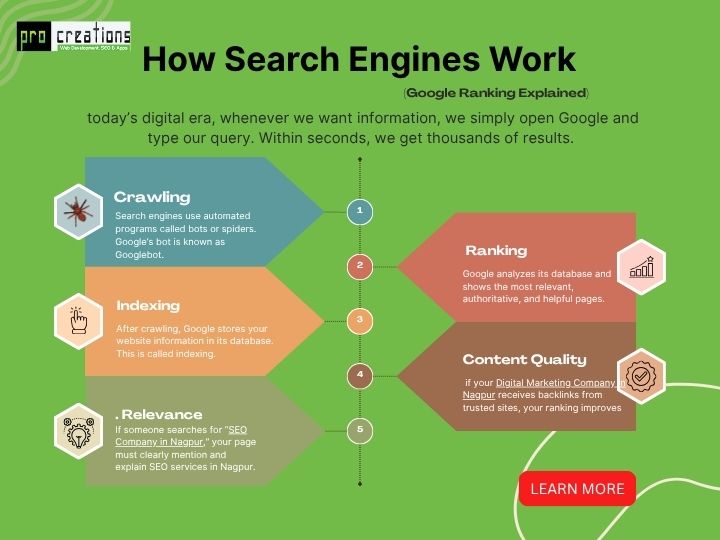
How Search Engines Work (Google Ranking Explained)

Complete Beginner’s Guide for 2026

In today’s digital era, whenever we want information, we simply open Google and type our query. Within seconds, we get thousands of results.

But have you ever thought:

The answer lies in understanding how search engines work and how ranking systems function.

In this detailed beginner-friendly guide by Pro Creations, we will explain everything step by step in simple Indian English, covering SEO, AI SEO, Answer Engine Optimization, and Voice Search Optimization.

What is a Search Engine?

A search engine is a software system designed to search information on the internet and show the most relevant results based on user queries.

Popular search engines include:

  • Google
  • Bing
  • Yahoo

Among them, Google dominates the market with the highest user base in India and globally.

The Three Main Steps of How Search Engines Work

Search engines operate in three primary stages:

  1. Crawling
  2. Indexing
  3. Ranking

Let us understand each in detail.

  1.  Crawling – Discovering Web Pages

Search engines use automated programs called bots or spiders.

Google’s bot is known as Googlebot.

These bots:

  • Visit websites
  • Read content
  • Follow links
  • Discover new pages

If your website is not crawlable, it cannot rank.

For example, if you run a Web Development Company in Nagpur but your website has broken links or poor structure, Google may fail to crawl it properly.

  •  Indexing – Storing Information

After crawling, Google stores your website information in its database. This is called indexing.

If your website is not indexed, it will not appear in search results.

To ensure proper indexing:

  • Use clear content
  • Avoid duplicate pages
  • Submit sitemap
  • Maintain clean URL structure

Professional Website Designers in Nagpur ensure proper technical setup for indexing.

  •  Ranking – Showing the Best Results

Ranking is the most important step.

When a user searches for:

Best Web Design Agency in Nagpur

Google analyzes its database and shows the most relevant, authoritative, and helpful pages.

Google uses hundreds of ranking factors.

Important Google Ranking Factors

1. Relevance

Your content must match the search query.

If someone searches for “SEO Company in Nagpur,” your page must clearly mention and explain SEO services in Nagpur.

2. Content Quality

Google prefers:

  • Original content
  • Helpful explanations
  • Updated information
  • Proper structure

Thin or copied content will not rank.

3. Backlinks

When other websites link to your website, it increases authority.

For example, if your Digital Marketing Company in Nagpur receives backlinks from trusted sites, your ranking improves.

4. User Experience (UX)

Google tracks:

  • Time spent on page
  • Bounce rate
  • Page speed
  • Mobile responsiveness

If your website loads slowly, users leave. Ranking drops.

5. Technical Structure

Technical SEO includes:

  • HTTPS security
  • Mobile-friendly design
  • Fast loading speed
  • Structured data
  • XML sitemap

A strong Nagpur Web Design Company understands the importance of technical SEO in ranking.

What is SEO in Search Engine Ranking?

SEO (Search Engine Optimization) is the process of optimizing your website to improve visibility in search engine results.

SEO includes:

  • On-Page SEO
  • Off-Page SEO
  • Technical SEO

If done correctly, businesses offering Web Design and Development in Nagpur can rank higher organically.

How AI is Changing Google Ranking

Google is no longer just a keyword-based search engine.

It uses Artificial Intelligence systems like:

  • Google RankBrain
  • Google BERT

These systems understand:

  • User intent
  • Natural language
  • Context of sentences
  • Meaning behind questions

This is called AI SEO.

Today, ranking is based on:

  • Search intent
  • Content depth
  • Clarity of explanation
  • Structured answers

What is Answer Engine Optimization (AEO)?

Answer Engine Optimization means optimizing content to provide direct, clear answers.

When someone searches:

“How do search engines work?”

Google may show a direct paragraph answer at the top.

To rank in answer boxes:

  • Use clear headings
  • Provide short direct definitions
  • Use bullet points
  • Keep explanations structured

AI systems prefer content that answers questions clearly.

Voice Search and Ranking

With the growth of voice assistants like:

  • Google Assistant
  • Siri

Users now search using voice.

Voice searches are:

  • Longer
  • Conversational
  • Question-based

Example:

Typed:
“SEO Services in Nagpur”

Voice:
“Which is the best SEO Services provider in Nagpur for small businesses?”

To optimize for voice:

  • Use natural language
  • Write conversational content
  • Answer full questions
  • Include local keywords

Local SEO and Google Ranking in Nagpur

Local businesses must focus on Local SEO.

If someone searches:

  • Website Design Company in Nagpur
  • Social Media Marketing in Nagpur
  • SEO Company in Nagpur

Google shows nearby businesses first.

Local ranking depends on:

  • Google Business Profile
  • Reviews
  • Location keywords
  • Local backlinks
  • Consistent business information

Businesses offering Web Design and Development in Nagpur must optimize locally to attract nearby customers.

How to Improve Google Ranking Step-by-Step

Step 1: Keyword Research

Find relevant keywords your audience searches.

Example keywords:

  • Website Designers in Nagpur
  • Best Web Design Agency in Nagpur
  • SEO Services in Nagpur

Use long-tail variations for better ranking.

Step 2: Optimize On-Page SEO

  • Use keyword in title
  • Add proper headings
  • Optimize images
  • Write detailed content
  • Add internal linking

Step 3: Improve Technical SEO

  • Increase website speed
  • Make mobile responsive
  • Secure website with HTTPS
  • Create sitemap

Step 4: Build Authority

  • Get quality backlinks
  • Publish informative blogs
  • Share on social media

For example, a Digital Marketing Company in Nagpur can publish educational blogs to build trust.

Step 5: Focus on AI-Friendly Content

  • Add clear definitions
  • Use structured formatting
  • Write human-friendly explanations
  • Provide in-depth knowledge

AI prefers clarity and context.

Common Mistakes That Affect Ranking

❌ Keyword stuffing
❌ Duplicate content
❌ Slow website
❌ Poor mobile experience
❌ Ignoring local SEO
❌ No content updates

Avoiding these mistakes improves ranking stability.

Why Ranking Matters for Businesses

If your business ranks for:

  • Web Development Company in Nagpur
  • Website Design Company in Nagpur
  • SEO Company in Nagpur

You receive:

  • Free organic traffic
  • Quality leads
  • Higher brand authority
  • Better conversion rates

SEO is a long-term investment.

Future of Search Engine Ranking

The future includes:

  • AI-driven search
  • Voice-first indexing
  • User experience signals
  • Video and visual search
  • Intent-based ranking

Search engines are becoming smarter every year.

Businesses must adapt to AI SEO strategies to stay ahead.

Final Conclusion

Understanding how search engines work is the foundation of digital success.

Search engines:

  1. Crawl websites
  2. Index content
  3. Rank pages based on relevance and quality

To rank higher, you must focus on:

✔ Strong SEO fundamentals
✔ High-quality content
✔ Technical optimization
✔ AI-based ranking signals
✔ Voice search readiness
✔ Local SEO strategies

Whether you are a student, entrepreneur, or business owner, mastering SEO and understanding Google ranking can transform your digital presence.

If you want your business to appear when people search for Website Design Company in Nagpur, Web Development Company in Nagpur, or SEO Services in Nagpur, you must apply structured SEO strategies consistently.

Search engine ranking is not magic. It is strategy, knowledge, and continuous improvement.

20 SEO-optimized FAQs

  1. How do search engines work?

Search engines work in three main steps: crawling, indexing, and ranking. They discover web pages using bots, store them in a database, and display the most relevant results when users search.

2. What is crawling in search engines?

Crawling is the process where search engine bots scan websites, read content, and follow links to discover new pages on the internet.

3, What is indexing in SEO?

Indexing is when a search engine stores and organizes website content in its database so it can appear in search results.

4. How does Google decide rankings?

Google ranks websites based on relevance, content quality, backlinks, user experience, page speed, mobile optimization, and many AI-driven ranking factors.

5. What are Google ranking factors?

Major ranking factors include high-quality content, keyword relevance, backlinks, mobile-friendliness, technical SEO, and user engagement signals.

6. What is SEO in simple words?

SEO (Search Engine Optimization) is the process of improving a website to rank higher on search engines and get free organic traffic.

7. What is the difference between crawling and indexing?

Crawling means discovering pages, while indexing means storing those pages in the search engine’s database.

8. What is AI SEO?

AI SEO refers to optimizing content according to AI-based algorithms like Google RankBrain and Google BERT that understand search intent and natural languag

9. What is Answer Engine Optimization (AEO)?

Answer Engine Optimization focuses on providing direct, structured answers so that content appears in featured snippets and AI-generated search summaries.

10. How does voice search affect SEO?

Voice search uses conversational queries through assistants like Google Assistant and Siri. Websites must use natural language and question-based content to rank for voice searches.

11. Why is mobile optimization important for ranking?

Most searches happen on mobile devices. Search engines prioritize mobile-friendly websites to provide better user experience.

12. What are backlinks and why are they important?

Backlinks are links from other websites pointing to your website. They increase trust and authority, improving ranking potential

13. How long does it take to rank on Google?

SEO usually takes 3 to 6 months to show visible improvements, depending on competition and optimization quality.

14. What is local SEO?

Local SEO helps businesses rank for location-based searches like “Website Design Company in Nagpur” or “SEO Services in Nagpur.

15. Why is page speed important for SEO?

Faster websites improve user experience. Slow websites increase bounce rate, which negatively affects ranking.

16. What is user intent in SEO?

User intent is the purpose behind a search query. AI systems analyze whether the user wants information, services, or products

17. Can small businesses rank on Google?

Yes. With proper keyword targeting, quality content, and local SEO strategies, small businesses can compete with larger companies.

18. What is technical SEO?

Technical SEO focuses on website structure, security (HTTPS), sitemap, schema markup, and crawlability to help search engines understand the site.

19. What are common SEO mistakes?

Common mistakes include keyword stuffing, duplicate content, slow website speed, ignoring mobile optimization, and not updating content regularly.

20. What is the future of search engine ranking?

The future of ranking includes AI-driven search, voice-first indexing, user experience signals, video optimization, and intent-based content evaluation.

Does Good Website Design Impact Your Online Marketing Efforts?

The importance of web design cannot be overstated, in this environment that is constantly changing. Your website goes about as the virtual retail store for your business, applying impact on client experience as well as on the results of your digital marketing drives. In this blog, we dig into the intricate connection between website design and digital marketing, separating the ways by which a precisely created online presence can essentially improve the viability of your overall marketing strategy.

The Establishments: Website Design and Development

Website design and development are the foundations of any online business. A visually engaging and user-friendly website captivates guests as well as ensures consistent navigation. At the point when users find it simple to explore your site, it improves their overall experience, adding to delayed commitment.

Choosing the right images and colors is only one part of designing a website that looks good. Web design remains closely connected with understanding the requirements of your target audience and correcting the website as needed. Consolidating responsive design elements is urgent, ensuring that your website looks perfect on different devices.

The Effect on Digital Marketing Strategies

1. Integration of Digital Marketing

A well-designed website serves as a solid foundation for your digital marketing efforts. Conversion rates are significantly increased when visitors are directed to a website that is both visually appealing and functional, regardless of whether you are using email marketing, pay-per-click advertising, or social media campaigns.

2. Search engine optimization- Friendly Structure

Search engines love well-efficient websites. Carrying out legitimate header tags, meta descriptions, and keyword-rich content can boost your website’s visibility on search engine result pages. A pleasant mix of significant keywords, including website design, web development, and digital marketing, can drive your website to the highest point of search rankings.

3. User Engagement and Retention

User engagement is a vital measurement in the progress of any digital marketing strategy. Visitors are more likely to stay engaged on a website that has compelling content, clear calls to action, and an intuitive design. The more users stay on your site, the more probable they are to convert into customers.

Tools and Techniques: Improving Your Website

1. Professional Web Design Tools

Investing in professional web design tools ensures that your webpage isn’t just visually engaging but in addition technically sound. Tools like Adobe XD, Sketch, or Figma empower designers to make consistent user experiences that line up with your brand identity.

2. Courses for Continuous Improvement

It’s important to keep up with the latest website design trends and technologies. Enrolling in courses that cover topics like UI/UX design, responsive website design, and the integration of design with marketing strategies enables your group to make cutting-edge websites.

Conclusion

In conclusion, the connection between great web design and effective online marketing efforts is harmonious. A very well-designed website turns into the key part of effective digital marketing, improving client experience, and driving conversions. You can position your business at the forefront of the digital landscape and leave a lasting impression on your audience by incorporating the right tools, and techniques, and continuing education through courses. Remember, that your website isn’t just a portal; it is a dynamic marketing tool that has the potential to take your company to new heights.

FAQs

Q1: How does website design impact user trust?

A1: A well-designed website instills trust in users, showcasing professionalism and attention to detail. Users are more likely to engage with and trust a company that invests in a visually appealing online presence.

Q2: Can a poorly designed website harm my SEO efforts?

A2: Yes, it can. Search engines prioritize user experience, and a poorly designed website may lead to higher bounce rates and lower rankings. Opting for a user-centric design positively impacts your SEO performance.

Q3: What role does website design play in branding?

A3: Website design is a crucial aspect of branding. Consistent branding across your site builds brand recognition and reinforces your company’s identity, fostering a connection with your audience.

3 Things You Need Before Redesigning Your Website

In the high-speed digital period, your website is often the first cooperation potential clients have with your business or company. A well-designed website can act as an incredible tool for attracting and retaining clients, improving your online presence, and boosting your main concern. Before diving into the exciting world of website redesign, there are three essential components you need to consider: social media marketing, SEO, and digital marketing.

Social Media Marketing: Improving Your Online Presence

In the domain of web design and development, social media marketing plays an essential part in connecting with your target audience. Coordinating your website seamlessly with famous social media platforms ensures that your company’s digital footprint isn’t just present but flourishing. If you want your website to have a cohesive online experience, you can get help from a professional website design company or agency.

Using social media marketing in your website redesign includes strategically placing social media icons and widgets to empower sharing and engagement. By consistently incorporating social media platforms into your website, you can extend your reach and make it easy for guests to connect with your business on different online channels.

SEO: Boosting Your Website's Visibility

Search Engine Optimization (SEO) is a basic part of website development and design. Ensuring that your website is upgraded for web search tools improves its visibility and ranking, driving organic traffic to your digital portal. You can get customized courses or services to learn more about SEO strategies and how they apply to your website from a professional website design company.

During the redesign process, focus on keyword optimization, meta tags, and other on-page SEO techniques to further develop your website’s search engine ranking. This attracts more visitors as well as positions your business as an expert in your industry, expanding trust and validity.

Digital Marketing: Creating an Effective Strategy

In the ever-evolving landscape of digital marketing, your website fills in as the central core for your online activities. A thoroughly examined digital marketing strategy, carried out by a skilled agency or utilizing the right tools and techniques, is crucial for the progress of your redesigned website.

Consider digital marketing agency packages that are in line with your company’s objectives. These packages might incorporate a combination of services, for example, content marketing, email campaigns, and online advertising. By selecting the right digital marketing approach, you can enhance your online presence and drive targeted traffic to your website.

Conclusion

In conclusion, careful consideration of SEO, social media marketing, and digital marketing strategies is necessary for a successful website redesign. By addressing to these key components, you can change your website into a strong online presence that attracts and retains your main targeted audience. Whether you decide on proficient help or leave on a DIY venture, focusing on these aspects will set the stage for a successful website redesign.

FAQs

Q1: How often should a company consider redesigning its website?

A1: Website redesign frequency varies, but it is generally recommended every 2-3 years or when significant changes in branding, technology, or business objectives occur.

Q2: Can I handle website redesign on my own, or do I need professional help?

A2: While some may attempt a DIY approach, seeking the expertise of a professional website design company ensures a polished and effective result.

Q3: What role does SEO play in website redesign?

A3: SEO is crucial in ensuring your redesigned website ranks well on search engines, attracting more organic traffic and improving visibility.

Q4: How can social media marketing benefit my website redesign?

A4: Social media marketing enhances your online presence, increases brand awareness, and encourages user engagement through seamless integration with your website.

A5: Yes, many online courses cover various aspects of website redesign, including design principles, development techniques, and digital marketing strategies.

Q6: What are the key elements of a successful digital marketing strategy for a redesigned website?

A6: A successful digital marketing strategy includes a mix of content marketing, social media campaigns, email marketing, and online advertising tailored to your business goals.

UI/UX Design in Nagpur, Web designing course in Nagpur Web design training institute in Nagpur, Website design and development in Nagpur,
Web design and user experience (UX) best experience

Introduction

In the fastly-growing domain of digital marketing, the success of any online venture pivots upon the cooperative energy between web design, development, and the consistent combination of user experience (UX). As businesses, organizations, and professionals attempt to establish their digital impression, understanding the complexities of web designing and development becomes fundamental.

Opening the Potential: Website Design and Development

Digital marketing, containing SEO, social media marketing, and e-commerce business, form the foundation of online achievement. Be that as it may, the foundation of a strong online presence lies in viable website design and development. A well-created website attracts customers as well as keeps them engaged, driving conversions and fostering brand loyalty.

Web Designing: A Mix of Creativity and Functionality

Web designing is a crafty combination of creativity and functionality, where Website designers play a critical role. A capable Website designer understands the significance of an elegantly satisfying and user-friendly interface (UI/UX). By coordinating instinctive navigation and eye-catching visuals, a website turns into a digital masterpiece, bringing users into an immersive experience.

Web Development: Building a Strong Online Presence

In addition, website design is the domain of web development, where Web developers carry life to the imagined plan. Creating consistent applications, portals, and catalogs requires a sharp comprehension of coding languages and development systems. A website’s optimal performance across a variety of devices and browsers is ensured by a skilled web developer.

The Elements of UI/UX: Lifting User Engagement

In the digital landscape, UI/UX is something other than language; it’s the heartbeat of user engagement. A thoroughly examined UI, combined with a consistent user experience, makes a lasting impact on visitors. Businesses and professionals enthused about elevating their online presence should focus on UI/UX to ensure that each click is a step toward conversion.

Tailored Solutions for Every Business: Packages and Offerings

As companies and agencies dig into the world of website design and development, customized packages become a game-changer. Offering thorough solutions for website creation, these packages take care of the particular necessities of businesses, ensuring an all-encompassing way to deal with digital marketing. Whether it’s an e-commerce business venture, an expert portfolio, or a corporate website, there’s a package designed for every requirement.

FAQs

Q1: What is the role of SEO in web design and development?

A1: SEO, or Search Engine Optimization, is integral to web design and development. It involves optimizing various elements of a website to rank higher on search engine results, thereby increasing visibility and driving organic traffic.

Q2: How important is social media marketing in conjunction with web design?

A2: Social media marketing complements web design by enhancing brand visibility and driving traffic to the website. Integrating social media buttons and creating shareable content can amplify a website’s reach.

Q3: Can UI/UX impact the conversion rate of a website?

A3: Absolutely. A seamless and visually appealing UI/UX significantly influences user engagement and can lead to higher conversion rates. Users are more likely to take desired actions on a website that provides a positive and intuitive experience.

In conclusion, the cooperative energy between digital marketing, web design, and development is the key to a successful online presence. Whether you’re an experienced professional or a growing business entrepreneur, understanding and implementing these best practices will indubitably set you on the path to digital success.b

Web design training institute in Nagpur, Web designing course in Nagpur, Website designing classes in Nagpur, Website development training institute in Nagpur, Digital marketing certification course,
The Ultimate Guide to the Best Web Design Tools for Success

Introduction

In the fast-paced world of digital business, the collaboration between web design, development, and digital marketing is essential for progress. Whether you’re an individual website designer, part of an agency or leading an e-commerce company, having the right arrangement of tools can essentially improve your productivity and output. In this blog, we’ll explore the top website design tools and techniques that take special care of different parts of application development, e-commerce, and website upgrades, ensuring you stay ahead in the competitive online landscape.

Website Design and Development

1. Website Design Tools for Creativity

As a web developer or designer, creativity is one of your strengths. Influence tools like Adobe Creative Cloud, Sketch, and Figma to create visually surprising websites and applications. These applications offer plenty of features to smooth out the design process and give a consistent user experience.

2. Efficient Website Development Packages

About website development, selecting the right packages and system framework is fundamental. WordPress, Joomla, and Drupal are well-known content management systems (CMS) that offer adaptability and versatility. These tools engage designers to make strong and dynamic websites for businesses and professionals.

3. Techniques for Responsive Design

Responsive design is a must in the age of mobile-first indexing. Bootstrap and Establishment are structures that work with responsive web design, ensuring your website’s look and capability perfectly across different devices. Executing these techniques is fundamental for a positive user experience and further developed search engine rankings.

Digital Marketing Integrating

4. SEO-Friendly Applications for Business Success

For any website or application to succeed, visibility on search engines is pivotal. Use SEO tools like SEMrush, Moz, and Ahrefs to lead keyword research, analyze competitors, and enhance your digital marketing strategy. For enhancing your online presence and attracting organic traffic, these tools are essential.

5. Digital Marketing Automation Techniques

Utilize automation tools like HubSpot, Marketo, and Mailchimp to streamline your digital marketing efforts. Computerize email campaigns, lead sustaining, and customer engagement, allowing your business or agency to focus on procedure and advancement rather than manual tasks.

In the domain of e-commerce business, where the visual appeal and functionality of a website directly influence sales, the right website design tools are essential. Powerful e-commerce platforms like Shopify, WooCommerce, and Magento offer a variety of features for designing stunning online stores. These platforms offer user-friendly interfaces and customizable template layouts, making them ideal for both small businesses and large enterprises engaged in web design for e-commerce.

Courses and Learning Resources

7. Web Professionals Benefit from Continuous Learning

Enroll in web development and design courses to stay up to date on the most recent technologies and trends. Platforms like Udemy, Coursera, and LinkedIn Learning offer complete courses for website designers and developers. Investing in continuous learning ensures that you stay at the cutting edge of the business.

Conclusion

In the unique world of website design, staying efficient and competitive is significant for success. By coordinating the right tools and techniques for application development, e-commerce business, and digital marketing, you can ensure your websites and applications meet as well as surpass user expectations. Whether you’re a website developer, designer, or part of a digital agency, the right tools can have a significant effect in conveying remarkable outcomes for your clients or business. Embrace the power of development and effectiveness, and watch your web projects flourish in the ever-evolving digital landscape.

FAQ

Q1: How can web design tools benefit my business?

A1: Web design tools enhance efficiency by providing a range of features and functionalities. They streamline the development process, improve user experiences, and contribute to the overall success of your online presence.

Q2: Are these tools suitable for individuals or only for agencies and companies?

A2: Many web design tools cater to both individual designers and larger entities like agencies and companies. The scalability of these tools allows them to adapt to the needs of various users.

Q3: Can these tools be used for both web and mobile app development?

A3: Yes, many of the highlighted tools in this blog are versatile and can be utilized for both web and mobile app development, ensuring a seamless and integrated workflow.

Q4: How can web design tools benefit my e-commerce business?

A4: Web design tools, such as Adobe Creative Cloud and WordPress, empower e-commerce businesses by providing visually appealing and user-friendly interfaces. These tools enhance the overall shopping experience for customers, leading to increased sales and customer satisfaction.

Q5: Are there any recommended courses to enhance web design skills?

A5: Numerous online platforms offer courses on web design, such as Coursera, Udemy, and LinkedIn Learning. These courses cover a wide range of topics, from the basics of web development to advanced techniques using popular tools like Adobe Creative Cloud and WordPress.

Web design training institute in Nagpur, Web designing course in Nagpur, Web development course in Nagpur, Digital marketing certification course, Digital marketing institute in Nagpur, website desigining company in Nagpur, web development agency in Nagpur, digital marketing company in Nagpur,
7 Reasons Why Your Business Needs a Responsive Website

Introduction

In the unique scene of digital marketing, a well-designed and responsive website is the foundation of an effective online presence. Whether you’re a carefully prepared organization or a growing startup, advancing resources into professional web design and development can fundamentally influence your business development. In this blog, we’ll go over seven compelling reasons why your business needs a responsive website.

1. Adaptive Digital Marketing Strategies

In the ever-evolving field of digital marketing, a responsive website is the glue that binds your online plans together. Your content will be accessible on all devices with the right approach to web design and development, resulting in a seamless user experience. This flexibility is fundamental for taking special care of the different preferences of your audience, helping your digital marketing efforts, and extending your online reach.

2. Upgraded User Experience for Better Business Results

A responsive website, made by an experienced website designer and developer, ensures an easy-to-understand interface. This raises the client’s user experience as well as diminishes bounce rates and boosts postponed commitment. A positive user experience on your website can help your business in the long run by turning visitors into devoted customers.

3. Professional Image and Credibility Boost

Your site is many times the primary source of contact between your business and expected clients. A professionally designed website sends a strong message about the integrity and authenticity of your company or organization. Investing assets into web designing courses for your group or hiring a genuine web development company guarantees that your online-based presence reflects the incredible skill and quality related to your brand image.

4. Customized Packages and Offers Showcase

A responsive website fills in as a virtual catalog for your products or services. It allows you to exhibit customized packages and special offers in an engaging and organized way. Whether your business revolves around courses, applications, or special offerings, a responsive design guarantees that your audience can undoubtedly explore your digital catalog, leading to expanded conversions.

5. Accessibility for Mobile Applications and Portals

In a time when mobile devices are used everywhere, a responsive website is the first step toward a smooth flawless mobile experience. A skilled web designer can enhance your website for both desktop and mobile platforms, guaranteeing that your application or portal is open to users quickly. This flexibility is essential for keeping a competitive edge and satisfying the needs of today’s high-speed digital landscape.

The functionality of your website reaches out past the customer-facing interface. A responsive site works with productive business management by giving a platform for streamlined communication, data collection, and analysis. Whether you’re running an e-commerce business platform or dealing with a professional services company, a responsive website goes about as the main center for your online operations.

7. Worldwide Business Expansion

A responsive website opens the doors to worldwide global business opportunities. It ensures that your content can be accessed by people all over the world, regardless of where they live. Whether you’re a local business or an international company, a responsive website design and development procedure establishes the base for worldwide development, allowing you to take advantage of different business sectors and develop your business significantly.

In conclusion, the significance of a responsive website in the present digital age couldn’t possibly be more significant. It is more than just a box on your checklist for your online presence; It is the key to unlocking your company’s full potential. Whether you’re focusing on digital marketing strategies, exhibiting your professional image, or growing universally, investing assets into a responsive website is an essential move that will without a doubt yield long-term benefits for your business.

Digital marketing certification course, Digital marketing institute in Nagpur, Web design training institute in Nagpur, Web designing course in Nagpur, Web development course in Nagpur, Website designing classes in Nagpur, Website desing classes fees, Website development training institute in Nagpur,
Web Accessibility- Designing and Developing for Inclusivity

Introduction

In the consistently advancing scene of digital marketing, website design, and web development, the inflection on making comprehensive online experiences has become vital. Today, website designing and website development are not just about experience; they are joined in with assurance availability for all clients, no matter what their capabilities. As an attentive company or organization, it’s vital to think about web accessibility in each part of your digital presence, from courses and offers to professional services.

Understanding Web Accessibility

Web accessibility includes designing and developing websites and applications that everybody can utilize, no matter what their physical or mental capabilities. It’s tied in with making a comprehensive digital space where users, whether or not they are near you or on the opposite side of the globe, can access information consistently. In the domain of website designing and development, this implies focusing on the requirements of assorted users, and ensuring that your site or application is easy to understand for everybody.

Web Design and Development Courses

As the interest in accessible digital experiences keeps on developing, there is a rising requirement for professionals who grasp the details of web accessibility. Signing up for web design and web development courses can furnish you with the information and abilities expected to make sites that take special care of a wide audience. These courses cover fundamental parts of web designing and development, ensuring that you are knowledgeable in the latest strategies and technologies.

Whether you are a website designer looking to improve your abilities or a beginner interested in joining the digital marketing industry, these courses give important experiences in making accessible websites. Learn how to integrate availability and accessibility highlights into your plans, making your design or creations easier to understand for people with assorted capabilities.

Company and Agency Services

If you’re running a web design company or web development company, offering web accessibility services should be primarily important. Numerous businesses are looking for professionals who can make externally amazing websites as well as ensure that those sites are available and accessible to everybody.

While advertising your services, feature your responsibility to inclusivity. Showcase the various packages you offer, emphasizing the significance of web accessibility in the present digital landscape. Whether you are dealing with an e-commerce portal, a business catalog, or a professional application, clarify that your designs focus on accessibility.

The Impact on Business

Past the moral basic of making comprehensive digital spaces, there are distinctive business advantages to focusing on web accessibility. Search engines progressively favor accessible websites, prompting further improved rankings. Also, an accessible website upgrades user experience; encouraging visitors to stay longer and connect more with your content. This, thus, can add to higher conversion rates and expand customer satisfaction.

In reality, as we know it where clients have countless choices readily available, businesses that focus on web accessibility put themselves aside from the competition. By ensuring that your digital presence is comprehensive, you sign to customers that you value their experience and are focused on serving a diverse audience.

Conclusion

Web accessibility is now a necessity rather than a choice in the ever-evolving fields of digital marketing, web design, and development. Whether you’re a website designer, part of a web development agency, or a business owner, embracing inclusivity in your digital presence is key to success.

Put resources into website design and development courses to remain on top of things, and consider how your company or agency can contribute to making the more accessible internet. By integrating accessibility into your designs and services, you improve your professional standing as well as contribute to a more comprehensive online world for all.

The Evolution of Web Designing: From Past to Future Trends

Introduction

Web designing has come a long way since the early days of the internet. From simple text-based layouts to visually stunning and interactive websites, the evolution of web design has been a fascinating journey. In this article, we will explore the past, present, and future trends of web designing, highlighting the key developments that have shaped the digital landscape.

The Birth of Web Design

In the early 1990s, the World Wide Web became accessible to the public, leading to the birth of web design. Websites were basic and primarily consisted of text and hyperlinks. The focus was on providing information rather than aesthetics. Designers used HTML as the primary language to structure the content, and early websites lacked the visual appeal we see today.

The Rise of Visual Elements

As the internet gained popularity, web design started to incorporate visual elements. Tables and images became common, allowing designers to arrange content more creatively. With the introduction of CSS (Cascading Style Sheets), the separation of content and presentation became possible, enabling more flexibility in website design.

Flash and Multimedia Era

The late 1990s and early 2000s witnessed the rise of Flash technology, bringing multimedia elements to websites. Flash animations, videos, and interactive content became popular, enhancing user engagement. However, Flash had its drawbacks, including slow loading times and compatibility issues, leading to its eventual decline.

Mobile Responsive Design

With the proliferation of smartphones and mobile devices, the demand for mobile-friendly websites increased. Responsive web design emerged as a solution, allowing websites to adapt to different screen sizes and devices seamlessly. Google’s algorithm updates also started favoring mobile-friendly sites, making responsive design a crucial aspect of modern web development.

Minimalism and Flat Design

In the early 2010s, minimalism and flat design gained prominence. Clean layouts, ample white space, and simple typography became popular. The focus shifted to user experience and ease of navigation. Websites embraced a more intuitive and user-friendly approach, promoting faster load times and better accessibility.

The Rise of Content Management Systems (CMS)

Content Management Systems like WordPress, Joomla, and Drupal revolutionized web design by making it easier for non-technical users to manage and update their websites. These platforms offered a wide range of template and themes, providing design options for various industries and purposes.

The Era of Parallax Scrolling

Parallax scrolling was a trend that emerged in the mid-2010s, adding depth and interactivity to websites. It created an illusion of 3D depth by moving background elements at different speeds compared to foreground elements while scrolling. Although visually appealing, its excessive use often affected websites performance and SEO.

Artificial Intelligence in Web Design

In recent years, Artificial Intelligence (AI) has started to influence web design significantly. AI-powered tools can analyze user behavior, personalize content, and automate design processes. This integration has allowed designers to create more personalized and dynamic experiences for website visitors.

Voice Search and Virtual Assistants

With the rise of voice search and virtual assistants, web designers are now optimizing websites for voice-based queries. Voice user interfaces (VUIs) have introduced new challenges and opportunities for designers to create voice-responsive and conversational interfaces.

The Future: AI-Driven Predictive Design

Looking ahead, AI-driven predictive design is expected to become more prevalent. Using machine learning algorithms, websites will dynamically adapt their layouts and content based on user preferences, behavior, and context. This will lead to even more personalized and immersive experiences for users.

Conclusion

The journey of web designing has been marked by significant milestones, transforming the way we interact with the digital world. From its humble beginnings as text-based pages to the futuristic possibilities of AI-driven design, web design continues to evolve and shape the future of online experiences. By staying updated with the latest trends and technologies, web designers can create websites that not only stand out in search rankings but also deliver exceptional user experiences, driving the internet into new frontiers.

web development
Most In-Demand Web Developer Skills in 2023

Web development is the art of coming up with ideas and making them a reality. The skills of a web developer are a combination of knowledge of computers and graphic design. It might change from one association to another, yet the general liabilities and range of abilities of web designers continues as before.


The abilities needed to land a job as a web developer are referred to as “web developer skills.” Candidates who are fluent in web development language will stand out from the crowd. Understanding HTML, designing skills, and analytical knowledge are prominent skills for web developers. But a skilled web developer also works on many other aspects of projects.

11 Essential Web Development Skills to Learn in 2023

Let us take a brief look at the most in-demand skills in web development.

1. Analytical Web Developer Skills

To build websites that work well, web developers need to be analytical. They need to make sure that the coding is perfect so that the websites work and are safe enough for people to use. Customers’ requirements must also be taken into account, analyzed, and easily modified to accommodate changes. Web developers are in charge of creating web pages that meet the client’s needs. The website will become better the more effectively the requirements of the customers are met.

2. CSS (Bootstrap, Flexbox and Grid)

If there is a web technology that cannot be replaced in addition to HTML, it must be CSS 3, or Cascading Style Sheet. CSS is used to style your website, which is to say, make it look better. Additionally, you can specify the element’s layout with CSS.

Similar to HTML, it is now rare to manually style web pages; instead, many individuals and teams use frameworks like Bootstrap, Tailwind CSS, Materialize, and others. CSS, like HMTL, is also changing, and you now have Grid and Flexbox.

You must learn CSS because it is necessary for any project you work on to look better. If you’re just starting, I recommend starting with basic CSS before moving on to new developments like Grid and Flexbox.

I suggest Advanced CSS and Sass as a resource if you need one: Animations, a Grid, Flexbox, and More! The course teaches you everything you need to know about CSS, including how to use Flexbox and Grid in 2023.


You can also check out these best CSS courses from Udemy and Pluralsight and these free online HTML and CSSS courses if you need more options.

3. JavaScript or Python Skills

When discussing the World Wide Web, JavaScript and Python, in addition to HTML and CSS, are also mentioned. It is one of the most important skills and qualifications for a web developer. JavaScript assists carry out complex highlights on a web with paging. The addition of moving parts, videos, and interactive maps all help to draw in more viewers due to JavaScript’s high-level programming. Developers can also use JavaScript to create interactive websites with special features like manipulating elements, algorithmic thinking, etc., which helps build a fun network on a digital platform.

4. Responsive Web Design Skills

A web developer must ensure that the design can be adapted to desktop, tablet, or Smartphone screen sizes. A website developed by a web developer must be responsive and compatible with a variety of device sizes. A website’s number of visitors is also affected by responsive web design. Therefore, in order to ensure that the website meets the requirements, it is necessary to upgrade to the most recent market trends and to remain relevant to the most recent design trends.

5. NPM (Node Package Manager)

Now that we’ve talked about the most important front-end development programming languages and frameworks, it’s time to talk about important web development tools. NPM comes in first. You no longer need to write code for everything you require, if you don’t already know.

For instance, if you want to make dynamic web pages, you don’t have to write a framework; you can just import the ones that someone else has already written and use them in your project.

NPM, or Node Package Manager, made this all possible. It is the largest software registry in the world and houses over 800,000 code packages.

NPM is technically a JavaScript programming language package manager. Additionally, it serves as Node JS default package manager, providing a JavaScript runtime environment for server-side development.

In addition to hosting online both public and private packages, it includes a command-line client known as npm for downloading those modules.

Even if you don’t know node, you should learn about NPM. You typically learn about NPM when you learn NodeJS. One of my favorite courses for learning NodeJS from the ground up is Andrea Mead and Rob Percival’s The Complete Node.js Developer Course on Udemy.

You can also check out these free Node JS courses and the best online Node.js courses for full-stack web developers if you need more options.